


Preparing Your Enterprise for the Video Tsunami
Share on Social

Customer and Employee Demand for Video Content Has Enterprises Scrambling
By Jim Lundy, Lead Analyst, Aragon Research
With video consumption surging at the consumer level, there is a growing demand for video at work. Enterprises are unprepared for this sea change in how video is used in employees’ everyday workflows. Enterprise video platforms, powered by AI, are the answer to the need to be able to deliver short- and long-form video while also offering video management and storage at scale.
Introduction
The enterprise video market is undergoing a profound shift, driven by technological advancements, evolving use cases, and increasing demand for video content. This research note explores the key trends shaping the market and provides guidance on how enterprises can take advantage of these trends to improve employee and customer experiences. The rapid growth of video presents both challenges and opportunities for businesses. Those who can adapt to the changing landscape will be well-positioned to succeed.
To effectively navigate this evolving market, businesses need to understand the key trends and develop a comprehensive video strategy. This strategy should address:
- Challenges and opportunities presented by the convergence of video and content management
- The growing importance of AI
- The rise of micro video (less than five minutes long)
- The changing needs of employees and customers, who are increasingly consuming video content on mobile devices
The Tsunami of Video Is Coming and Enterprises Are Not Prepared
The demand for video content is increasing at an unprecedented rate, driven by the popularity of platforms such as YouTube Shorts and TikTok. This surge in video consumption by consumers is now permeating into the workplace and creating a “tsunami” of video data that many enterprises are not prepared to handle. They lack the infrastructure and expertise to manage, deliver, and analyze video content effectively. Inadequate preparation can lead to missed opportunities and degrade employee and customer experiences.
Often, organizations are unprepared because they rely on outdated tech and don’t fully grasp how strategically important video has become. Many IT departments have historically underinvested in video infrastructure, leaving businesses ill-equipped to handle the growing surge in video demand.
The other issue is that existing content management systems were designed for documents and can often only accommodate small video files. They also cannot do transcoding or support embedding video files in third-party sites and applications, so the playback of videos is problematic.
Video Content Has Not Been Viewed as Strategic, But That Is Changing
In the past, video content was often treated as an afterthought and was perceived as a content type that was hard to produce, let alone do well. However, this is changing as businesses realize the power of video to engage employees and customers. Video is now seen as a strategic asset that can help businesses achieve their objectives. This shift in perspective is leading to increased investment in video infrastructure and expertise.
As use cases evolve, organizations are realizing the opportunity video has to drive sales, improve customer satisfaction, and boost employee engagement. This value is becoming increasingly clear as businesses see the impact it can have on their bottom line, and as a result, they are looking for additional ways to integrate it more deeply into their overall strategy.
Shifting From a Document to a Video-Based Information Approach in the Enterprise
Enterprises are shifting from a document-centric to a video-centric approach to information sharing. Video is more engaging, easier to consume, and more effective at conveying information. As a result, video is becoming the preferred format for communication, training, and knowledge sharing. This shift is being driven by the increasing availability of video creation and editing tools, as well as the growing popularity of video-sharing platforms.

The new landscape has implications in two different ways. First, as the demographics of the workforce change, younger employees are more likely to prefer and consume video content. Digital natives will soon become the majority of the employee base, and businesses must rethink their content strategy and invest in the necessary infrastructure and tools. Second, as video becomes a preferred method for communication, businesses will be required to manage and secure that content so the right information is accessible by the right people.
Video is a powerful communication tool and is more effective than text on a page, which makes it the ideal way to provide instructions and information. When video is stored in a central hub (i.e., EVP), it can be embedded in other business process applications and becomes more effective because the information people need is available within these systems, where people are getting work done (i.e., Salesforce or ServiceNow).
The Video Era and the Need for Better Employee Experiences
The IT team is seeing increased demand for video. Part of this is because employees expect better experiences, and video can play a key role in delivering on those initiatives. Video can be used for training, communication, and collaboration. It can also be used to create a more engaging and immersive onboarding journey.
By using video to enhance employee experience, businesses can attract and retain top talent. In fact, data over the last several years suggests that 65% of employees are visual learners and prefer video content. A user can recognize visual content faster—in as little as 13 milliseconds, according to research done by MIT.
Other benefits of video consumption:
- Boosts learner engagement and participation
- Improves learner satisfaction
- Accelerates comprehension of visual information
- Increases information recall
Video can also help enhance employee engagement and productivity, which leads to a more positive work environment and ultimately a more successful business.
Why Traditional Enterprise Content Management Approaches Have Failed
Traditional enterprise content management (ECM) approaches have failed to meet the requirements of video because they are typically designed with features and functionality to effectively manage documents, not video files. This can lead to challenges with video storage, search, and delivery. The limitations of traditional ECM systems are becoming more apparent as the volume of video content continues to grow. Businesses are finding that traditional ECM systems are not able to keep up with the demands of video.
Furthermore, ECM databases are often not optimized for video, which can lead to performance issues. Video files are typically much larger than document files, and they require different storage and retrieval mechanisms. Traditional ECM systems often struggle to handle these unique video requirements, which can result in frustration for users and a reluctance to embrace video as a strategic asset.
Enterprise video systems can store video in a more secure and transparent way, creating a database that makes it easier for users to search for specific content.
The Need for a Modern Content and Video Architecture
There is a problem facing enterprises, and it is the proliferation of video repositories that are often tactical purchases, are often not secure, and are often not managed. This approach puts the business units and the content itself at risk. CIOs and CTOs need to work with the business units for a comprehensive video strategy.
Enterprises need a modern content and video architecture to meet the challenges of the evolving video landscape. At a high level, this architecture should:
- Manage both video and other types of content in a unified way.
- Support the latest AI-powered features and the growing demand for micro video.
- Improve the efficiency and effectiveness of video operations.
- Provide robust security and compliance for video content.
- Create storage and retention policies for video content.
- Support the creation and delivery of video experiences with features such as live streaming, video editing, embedding/integrations, and video analytics.
By providing a comprehensive platform for video, businesses can empower their employees and customers to use video effectively, improving their workflows, knowledge sharing, and productivity.
Enterprise Video Getting a Seat at the Table
Figure 1 shows the growing need for video and micro video in the enterprise—across all tech stacks and functional groups.
Enterprise video is becoming a must-have part of every enterprise tech stack. While all functional groups in the enterprise need video content, most of the applications each business unit has are not equipped to solve the video dilemma. The answer is making an enterprise video platform part of the overall enterprise software architecture. There is also more to it than just delivering video, especially when it comes to adhering to compliance and regulatory requirements.
Enterprise Video Solves the Compliance and Archiving Requirement
Just like there are document archiving requirements, there is a growing demand to retain and archive video, particularly if it is used for training and internal or external communications. This is one of the most overlooked areas, and an enterprise video platform can be configured to do exactly that—to save and archive critical video content.
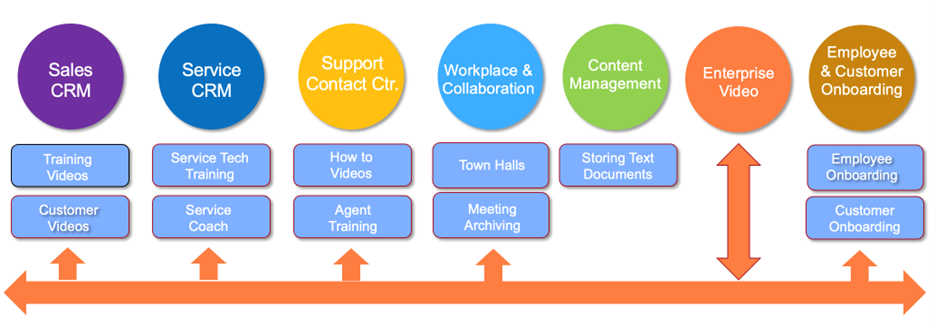
Enterprise video is getting a seat at the table as a critical part of the tech stack. Since nearly every functional group in the enterprise needs a modern approach, EVPs will serve that need.
Leveraging and Managing Existing Video Content
The growing volume of video recordings from meetings, town halls, trainings, and webinars accentuates the many islands of video in the enterprise, often stored within individual business units and not part of an enterprise-wide repository. Putting that video content to work and merchandising it by centralizing it within an enterprise video platform provides better access and the opportunity to repackage it into micro videos.
Micro Video and Short-Form Video Are the Future
One compelling reason to implement an enterprise video system is that all of the islands of video can be leveraged to deliver shorter videos. Micro video, a growing trend in the enterprise video market, is changing the way businesses create and deliver video content. Many enterprise video providers offer the ability to take a section of a video and create a smaller video, which is called clipping.
Because it is designed to be consumed quickly and easily, it’s ideal for training, customer support, and information sharing. The popularity of micro video is driven by accessibility on mobile devices, and it also captures the short attention spans of today’s employees and customers.
Micro video is particularly well-suited for providing just-in-time learning and quick answers to questions. It is also an effective format for sharing company news and updates. Micro video enables the creation of multiple clips from one source, contributing to the video tsunami phenomenon and creating more video content to manage and store. As the demand for micro video continues to grow, businesses will need to invest in the tools and technologies, such as AI summarization capabilities, needed to create and deliver this type of content in a captioned or simplified form (see Figure 2). Micro video is the fuel that is driving consumption among users. The more engaging micro video that enterprises have, the greater the demand will be.
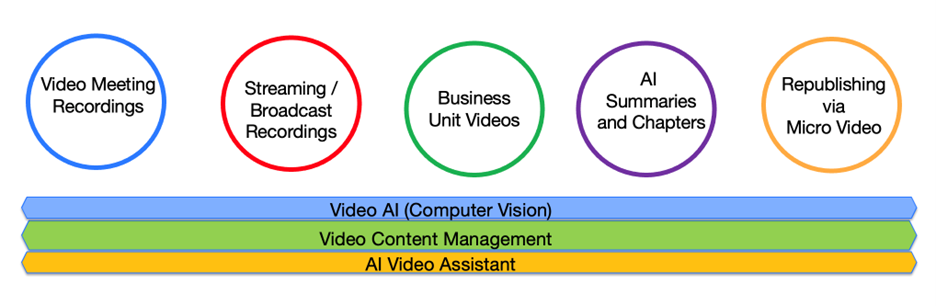
There are many islands of video today, and enterprise video helps to manage them and republish them in smaller micro video segments.
Video AI and Computer Vision—the Algorithm Is Key to Experience
AI is playing an increasingly important role in the enterprise video market because it can be leveraged to make video content more discoverable, engaging, and effective. AI-powered features such as summarization, search, and recommendations help users access the most relevant video content—wherever the videos are embedded.
AI is also being used to create new video experiences, such as interactive video and easier editing. In many scenarios, video is being used during shopping and purchasing experiences. In this case, a “buy now” button might appear. In other cases, movement or action can be highlighted as part of a video playback. For security and surveillance applications, automatically applying tags and markers helps users understand what is happening with fewer playbacks.
AI can also be used to improve audience accessibility. For example, AI can generate captions and transcripts, making video content more accessible to people who are deaf or hard of hearing. It can also translate videos into different languages so global audiences can benefit from the content. While enterprise video platforms are embracing AI, incorporating computer vision into the platform will be key to creating intelligent video assistants (see Figure 3).
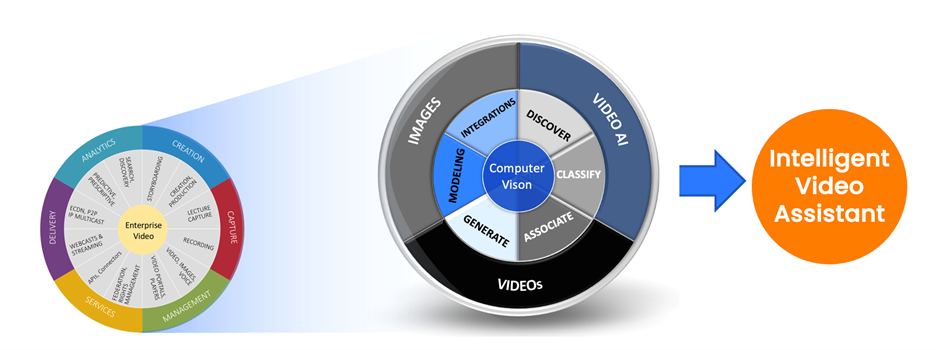
Computer vision is key for enterprise video providers to offer intelligent video assistants.
Video AI and Search—Locating Scenes Faster
Video search is another area where AI comes into play. AI-powered search engines can understand the content and concepts of videos, and not just look at keywords. This capability makes them more searchable, enabling users to find the videos they are looking for and generating personalized results that are more relevant to individual users. Analytics can then be used to gain insights into video searches, consumption, and viewing behavior, which helps businesses improve their video and content creation strategy.
Video AI and Generating New Video Content
AI saves time and money when used to make new video content. For example, AI can be used to generate summaries of longer videos or short clips from live events, as well as create new forms of video content, such as interactive video and virtual reality experiences. AI is a powerful capability that helps businesses improve the effectiveness of their video content. It’s serving as a force multiplier now, equipping organizations with the tools to rapidly generate targeted content on the fly from business materials like documents or branded images.
In 2025, there has been a significant evolution in video AI that includes the ability to generate entirely new, high-fidelity video content from text prompts and other inputs. This capability, powered by sophisticated generative models, translates natural language descriptions into dynamic video scenes. The underlying technological advancements in deep learning, which leverage massive datasets of text and video, are making professional-grade video creation accessible without the need for traditional production resources like cameras, crews, or studios. This marks a fundamental shift from editing existing content to creating it from scratch.
Beyond straightforward text-to-video conversion, these models are becoming more adept at producing longer, more coherent scenes with consistent characters and objects. They can be guided by still images to animate a photograph into a moving scene, or they can modify existing video clips based on textual commands. This provides a high degree of creative control, enabling users to specify camera movements, artistic styles, and complex actions. The technology allows a user to function as a virtual director, shaping a visual narrative through simple instructions.
The implications for the enterprise are substantial and extend beyond marketing and advertising. Product teams can use these tools to rapidly prototype concepts, training departments can create customized learning modules, and sales teams can generate personalized outreach videos at scale. This trend democratizes video production, lowering the barrier to entry for creating compelling visual content. Organizations that fail to explore these generative tools risk falling behind in their ability to quickly develop creative assets, personalize communications, and engage audiences with novel forms of storytelling.
Critical Use Cases
There are a number of critical use cases for enterprise video. These include:
Employee Experience
Video can be used to improve employee experience in a number of ways. For example, video can be used for training, communication, and collaboration, leading to increased engagement and productivity. It can also be used to create a more engaging and immersive onboarding experience. By using video to improve employee experience, businesses can attract and retain top talent. Video can also help to improve employee engagement and productivity, which leads to a more positive work environment and a successful business.
Video can also be used to support diversity and inclusion initiatives to foster a more welcoming workplace for all employees. For example, video can be used to create training programs on unconscious bias or to share stories of employees from different backgrounds.
With the right enterprise video platform, these videos can be embedded in business process applications, allowing employees to access relevant information right where they work. For example, sessions about benefits enrollment can be added to intranets, or recorded client meetings can be embedded within customer records in a CRM. By using video to improve employee communication and knowledge sharing, businesses can create a more connected and informed workforce.
Training and Professional Development
Video is a powerful tool for learning, particularly for businesses with remote or hybrid work models. It can be used to deliver training, provide customer support, and share company updates. Video can also be used to create more engaging and interactive learning experiences, as well as improve knowledge retention and reduce training costs. By using video for learning and development, businesses can ensure that their employees have the skills they need to succeed.
Personalized learning can be enhanced with video. For example, AI can be used to recommend video content to employees based on their role, skills, and interests, helping employees develop the skills they need to advance their careers.
Just-in-Time Learning for Front-Line Workers
Whether agents in a call center or technicians in a manufacturing plant, front-line workers need access to information quickly and easily. Video is an ideal format for delivering just-in-time learning to these workers. Micro videos can be used to provide short, targeted training modules that can be accessed on demand, allowing front-line workers to stay up to date on the latest information and procedures. Video can also be used to provide front-line workers with real-time support, which helps them to resolve issues quickly and efficiently. Making information available to front-line workers at their fingertips—wherever they are—improves customer satisfaction and operational efficiency.
In addition, having access to video creation and delivery tools empowers front-line workers to share their knowledge and expertise. For example, they can create videos to demonstrate best practices and instructions or to share tips and tricks with their colleagues. This can help to create a more knowledgeable and engaged workforce.
Customer Use Cases
Video can be a powerful way to improve customer experience. For example, videos could be embedded on customer portals and community pages, used for training, and leveraged to promote new offerings. In many cases, products such as Microsoft Teams are not as well-suited for external use cases where there are more requirements around ease of use, accessibility, and performance.
Support
Enhancing customer experiences is a key area where video can have an impact. Video can be used to provide a better customer experience across the entire journey—from onboarding to training to support. How-to and tutorial videos, product demos, and FAQs can streamline and accelerate the setup or deployment process. They can also be used to enable self-service and deflect cases when embedded in a ticketing or case management platform such as ServiceNow.
Ongoing training and certifications can be delivered using video. Video can also be used to create a more immersive and interactive learning experience. For example, businesses can use video to create simulations and role-playing exercises that help customers learn by doing. This helps improve knowledge retention and engagement.
Live customer support is possible with video, and when those recordings are stored in an EVP, they can be embedded in CRMs. This helps businesses resolve customer issues more quickly and efficiently, personalize interactions, plus save time for support and account teams by centrally archiving video records.
Enhancing the customer experience in these seemingly small ways has a big impact on strengthening relationships and reducing costs, improving satisfaction, enabling self-service, and retaining business.
Training and Professional Development
Using live or recorded video to deliver customer training, such as product tutorials, onboarding videos, and certification programs, is just one example of ways to improve satisfaction and loyalty. Video can also help to reduce support costs, particularly when on-demand videos are embedded on a customer portal to increase self-service opportunities. By using video for customer training, businesses can ensure that their customers have the knowledge they need to be successful.
Video can create a more interactive customer training experience. For example, businesses can use video to create simulations and role-playing exercises that are more immersive and help customers learn by doing, improving engagement and knowledge retention.
One of the reasons that YouTube has grown so much is due to the how-to videos posted there; it is much easier to learn when you can follow along visually. However, oftentimes, training content shouldn’t be publicly accessible, needs tight security, and must be free of ads, making YouTube a less-than-ideal platform. Internal and customer training can be one of the largest use cases in justifying an enterprise video platform because of its inherent security protocols and viewer roles and permissions.
Industries That Will Leverage Modern Video Architectures
A number of industries are well-suited to leverage modern video architectures, which make it possible to easily store videos regardless of the vertical or use case, and make them available for content creation, embedding on sites, and more. These include:
Energy
The energy industry can use video to train employees, provide customer support, and improve safety. Video can also be used to communicate with stakeholders about energy projects and to promote energy efficiency. The energy industry can also use video to monitor and manage energy infrastructure. By using video, energy companies can improve operational efficiency, reduce costs, and enhance safety. For example, video can be used to provide real-time training to field workers on how to operate new equipment or to perform maintenance tasks safely. Video can also be used to document safety procedures and to provide employees with just-in-time safety training.
Financial Services
Financial services, including both banking, insurance, and even brokerages, need video from a training perspective—both for employees and how-to videos for retail and commercial customers. Also, for Insurance, video and image content is increasingly being used for claim processing, and given the volume growth, it needs to be managed.
Due to regulations, videos involved with aspects of the business, such as customer-facing videos and business process videos (e.g., claims), will also need to be stored and managed for regulatory compliance just as it is done for text-based documents.
Manufacturing
Training employees, providing field or customer support, and improving quality control are critical functions for manufacturers in which video can play a significant role. Whether the videos are professionally made or created by users on their mobile devices, videos that demo a product or document manufacturing processes are invaluable. The manufacturing industry can also use video to monitor and manage production lines, broadcast important information in plants, and share critical updates. By using video, manufacturers can improve productivity and safety protocols, reduce costs, and enhance quality. For example, video can be used to provide employees with step-by-step instructions on how to assemble products or to operate machinery. Video can also be used to document quality control procedures and to provide real-time feedback to employees on their performance.
Healthcare and Telehealth
Given the distributed and mobile nature of the healthcare industry, video is an ideal solution for providing telehealth services, training medical professionals who are frequently mobile, and informing patients about their health. Medical professionals can conduct virtual consultations or remotely monitor patients’ vital signs using video. Video can also improve patient engagement and compliance by offering educational videos on their conditions and treatments. An EVP with robust governance and security can ensure that personally identifiable information (PII) is protected. These use cases and others enhance employee and patient experiences, reduce costs, and expand access to care.
Retail
Retail is in a race for consumers and winning them over often comes down to whether or not they feel engaged with the product or service. Positive shopping experiences can be enhanced with interactive product demos and video buying guides. Today, more and more product micro videos are part of the buying journey and can increase conversions from shopping to purchasing.
How to Get Started with Enterprise Video—Culture and Technology
Enterprises that are looking to get started with enterprise video should focus on two things: culture and technology.
- Culture: Enterprises need to create a culture that embraces video. This means more than holding monthly executive broadcasts; all employees should be encouraged to create and share video content. It also means providing employees with the training and tools they need to create high-quality video content. It is also important to have a clear video strategy and to communicate it to employees. This will help to ensure that everyone is on the same page, that the video is used effectively, and that best practices are followed.
- Technology: There must be an investment in the right technology to support an enterprise-wide video strategy. This includes deploying an enterprise video platform that serves as a central hub to federate video assets and make it easier to secure, manage, deliver, and analyze video content. The enterprise video platform must include AI-powered features to improve the effectiveness of video content and streamline managing it at scale. It is also critical that the platform can integrate the stored video with other business process applications to ensure that content is accessible seamlessly across the enterprise.
Aragon Advisory
- A tsunami is coming, and enterprises must prepare for the surge in video demand, which will help drive faster and more strategic outcomes.
- The document-centric approach to content is winding down—new approaches require embracing modern media, including video streaming and video content.
- Enterprises should establish best practices and examples of short-form videos so that associates can model these approaches. Enterprises should find a balance between giving employees the freedom to create and share this type of content and protecting confidential information.
Bottom Line
The demand for video is exploding, and enterprises are not prepared in part because traditional document-based content management approaches were never designed to store and deliver video. The modern video AI era is here, and with it comes a new way to streamline information sharing, simplify knowledge transfer, and keep both employees and customers engaged. There are significant opportunities to enhance on-the-job learning that can be interesting and fun, while maintaining business protocols and ensuring security. Enterprises need to act now to prepare for this revolution and start with a scalable enterprise video platform.