

Edge Caching

Achieve up to 99.5% Bandwidth Savings for Live and On-Demand Video Streaming

Edge Caching

Achieve up to 99.5% Bandwidth Savings for Live and On-Demand Video Streaming

Edge Caching2026-08-14T15:53:52-04:00

A Single, Cost-Effective Solution for High-Quality Live and On-Demand Video

Vbrick Edge Caching brings video closer to your viewers by storing it on servers you already own, at the edge of your enterprise WAN. The first person at a site pulls the stream; everyone after them watches from the local cache.

It is a software-only enterprise content delivery network (eCDN) with a one-time setup, and it works the same way for live broadcasts and on-demand playback.

Why Enterprises Use Edge Caching for Video

Our caching software, placed strategically on servers at the edge of the enterprise WAN, retrieves and stores video fragments locally. Subsequent viewers in the same location access the video directly from the local cache, reducing traffic on the corporate internet connection and WAN links. This preserves bandwidth for critical applications, providing employees with a high-quality, glitch-free experience with faster start times.

  • Software-only. Installs on servers you already run — no appliances to buy, rack or maintain.

Scales with one setup. Add locations without redesigning the deployment.

  • Cheaper than more bandwidth. An alternative to upgrading WAN links to absorb peak video load.

  • Centrally managed.One cloud console for every cache, with cache routing rules controlling which sites serve which content.

What Is Edge Caching?

For websites, that usually means caching images, stylesheets, and scripts across a public content delivery network. For enterprise video, the problem is different in kind, not just in scale.

Edge Caching for Enterprise Video vs. Website Caching

A public CDN caches at the edge of the internet. That gets video as far as your building — and then stops. The bottleneck in a corporate all-hands is not the journey from the origin to your ISP; it is the last leg, where several thousand employees on one campus each open an independent stream across the same WAN link.

An enterprise content delivery network caches inside your network instead. Vbrick Edge Caching places caching software on servers at the edge of your enterprise WAN. The first viewer in a location pulls the video fragments; everyone after them streams from the local cache. One stream crosses the WAN instead of thousands, and bandwidth stays available for the applications your business runs on.
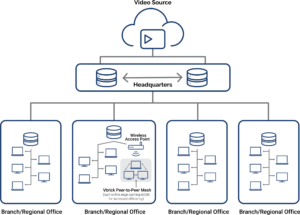
Edge Caching Network Diagram

How Vbrick Edge Caching Works

  1. Deploy. Caching software is installed on existing servers at each location. No dedicated appliances and no infrastructure purchase — it is a software-only, one-time setup.
  2. Cache on first request. The first viewer at a site requests the stream. The edge cache retrieves the video fragments and stores them locally.
  3. Serve locally. Every subsequent viewer at that site is served from the local cache. Start times drop, buffering stops, and the corporate internet connection stays clear.
  4. Manage centrally. All caches are configured and monitored from one cloud console, with cache routing rules that determine which locations serve which content.

This works identically for live broadcasts and on-demand playback — the same cache serves a town hall in progress and the recording watched a week later.

Vbrick Universal eCDN

Vbrick Universal eCDN is the only solution on the market with three advanced eCDN technologies: peer-to-peer, edge caching, and multicast. Use any combination to deliver your message at scale securely and without interruption.

Security, Management and Integration

Top-Tier Security and Compliance

Experience top-tier security and compliance:

  • FedRAMP-certified
  • SOC 2 Type II accredited
  • GDPR-compliant

Our encryption secures your video both in transit and at rest.

Take control of your video ecosystem with deployment options behind your organization’s firewall.

Simple Cloud Management and Analytics

Enjoy a centralized platform for ongoing management, monitoring, and in-depth analytics.

Gain insights with comprehensive real-time and post-event analytics, down to individual end-user device.

Ensure uninterrupted service with high availability and heartbeat monitoring.

Advanced Integration Capabilities

Embrace deep integrations with Webex Webinars and Microsoft Teams, including town hall support.

Support various streaming sources, protocols, and delivery methods.

Tailor your experience with custom or bespoke integrations using our software development kit (SDK).

Frequently Asked Questions

A public CDN caches content at the edge of the internet, close to cities and ISPs. Edge caching in an enterprise context caches inside your own network, on servers at the edge of your WAN. A CDN reduces the distance from origin to your building; an enterprise edge cache eliminates duplicate traffic within it. Large organizations typically use both.

An eCDN is a content delivery network built for private corporate networks rather than the public internet. It uses techniques such as edge caching, peer-to-peer distribution and multicast to deliver video to large internal audiences without saturating WAN links. Vbrick Universal eCDN combines all three.

Usually yes, if you broadcast to large numbers of employees in shared offices. A CDN delivers one copy to the edge of your network; without an eCDN, that copy is then duplicated once per viewer across your internal links. Edge caching is what stops that duplication.

It is software-only and installs on existing servers at each location, with a one-time setup and no dedicated hardware. Caches are then managed centrally from a cloud console.

Edge caching stores video on a server at each location. Peer-to-peer distributes fragments between viewer devices with no server required. Multicast sends a single stream that the network replicates to many viewers. Each fits a different network topology, which is why Vbrick Universal eCDN offers all three and lets you combine them.

{ "@context": "https://schema.org", "@type": "FAQPage", "@id": "https://vbrick.com/edge-caching/#faq", "isPartOf": { "@id": "https://vbrick.com/edge-caching/" }, "mainEntity": [ { "@type": "Question", "name": "What is the difference between edge caching and CDN caching?", "acceptedAnswer": { "@type": "Answer", "text": "A public CDN caches content at the edge of the internet, close to cities and ISPs. Edge caching in an enterprise context caches inside your own network, on servers at the edge of your WAN. A CDN reduces the distance from origin to your building; an enterprise edge cache eliminates duplicate traffic within it. Large organizations typically use both." } }, { "@type": "Question", "name": "What is an enterprise content delivery network (eCDN)?", "acceptedAnswer": { "@type": "Answer", "text": "An eCDN is a content delivery network built for private corporate networks rather than the public internet. It uses techniques such as edge caching, peer-to-peer distribution and multicast to deliver video to large internal audiences without saturating WAN links. Vbrick Universal eCDN combines all three." } }, { "@type": "Question", "name": "Do I need edge caching if I already have a CDN?", "acceptedAnswer": { "@type": "Answer", "text": "Usually yes, if you broadcast to large numbers of employees in shared offices. A CDN delivers one copy to the edge of your network; without an eCDN, that copy is then duplicated once per viewer across your internal links. Edge caching is what stops that duplication." } }, { "@type": "Question", "name": "What does it take to deploy Vbrick Edge Caching?", "acceptedAnswer": { "@type": "Answer", "text": "It is software-only and installs on existing servers at each location, with a one-time setup and no dedicated hardware. Caches are then managed centrally from a cloud console." } }, { "@type": "Question", "name": "How does edge caching differ from peer-to-peer and multicast?", "acceptedAnswer": { "@type": "Answer", "text": "Edge caching stores video on a server at each location. Peer-to-peer distributes fragments between viewer devices with no server required. Multicast sends a single stream that the network replicates to many viewers. Each fits a different network topology, which is why Vbrick Universal eCDN offers all three and lets you combine them." } } ] }

Talk to an Expert

Choose Vbrick for expert support in architecting and deploying your enterprise video distribution technology. Our seasoned team will create a tailored eCDN solution to meet your organization’s current and future needs.

Go to Top