

What is Enterprise Video Streaming?
Share on Social

Enterprise video streaming is the delivery of live and on-demand video to an entire workforce over the corporate network, using infrastructure built to handle the scale, security, and network constraints of a large organization. The difference from a consumer platform is not what the viewer sees. It is what happens to the network when 10,000 employees press play at the same moment.
How Enterprise Video Streaming Differs from Consumer Platforms
The visible features overlap. The infrastructure does not.
Scale behavior. A consumer platform sends one stream per viewer over the public internet, where capacity is somebody else’s problem. Inside a company, those streams cross links you own and pay for. An enterprise platform pairs with an enterprise content delivery network so a single stream can reach a whole site.
Access control. Consumer platforms offer public, unlisted, or password-protected. Enterprise platforms authenticate against your identity provider, so a results briefing is visible to the finance leadership group, and nobody else, and access changes when someone leaves.
Retention and governance. Video that contains commercial or personal information falls under the same retention, legal-hold and data-residency obligations as any other record. Consumer platforms make no such provision.
Search and reuse. An enterprise library is worth little if nobody can find anything in it. Automatic transcription, in-video search and translation are what turn an archive into something employees actually use.
Reporting. Marketing metrics measure reach. Internal communications needs to know which sites had degraded playback, who has completed a mandatory training video, and where a stream dropped.
Besides scalability, an enterprise video streaming platform offers certain features that a content creator simply wouldn’t need. A virtual event in a corporate environment needs to meet different technical requirements that a spontaneous Facebook Live video wouldn’t provide. In addition, an enterprise streaming platform often serves more purposes than live video streaming alone.

From Live Streaming to Employee Engagement: Benefits of an Enterprise Video Platform
Enterprise video streaming is a form of video communication that enables major corporations to create a great video experience for a large number of users without overwhelming their network bandwidth.
An enterprise video platform (EVP) is specially equipped with the technical capabilities needed to handle video streaming functions at an enterprise scale, making it the software solution of choice for companies needing enterprise-grade streaming service.
Enterprise video streaming unlocks the power of video for the enterprise, enabling companies to:
- Engage distributed workforces at scale: Video enables collaboration and communication between employees spread across the world, maintaining high engagement for remote workers.
- Ensure the transmission of important information: Enterprise video streaming ensures employees are able to access critical information they need to complete their jobs, including training, orientation, internal communication, and company updates. At the same time, they make it easier for you to adhere to security standards and protect your organization.
- Organize live stream events: Whether for internal communication or public announcements, a live event is a great way to drive engagement and embed visual branding and personality in your communication strategy
Why businesses need enterprise video streaming in today’s world of work
Organizations with geographically distributed employees have unique video streaming needs that can be difficult to resolve without the right technology solution. Here are some of the enterprise video streaming challenges facing today’s companies:
Streaming video at scale
The transition to hybrid and remote work models allowed some companies to grow significantly beyond their traditional workforce capacities, giving them access to highly qualified talent in previously inaccessible parts of the world. Although the advantages were significant, this also created a new challenge: Companies could no longer predict with certainty how many people would need to stream video over corporate networks on any given day, creating serious headaches for IT staff.
As the foundation of every solid enterprise video strategy, an enterprise video solution enables businesses to support an undefined volume of video traffic on their corporate networks. Whether 15 or 15,000 people are accessing a video asset, these tools allow businesses to deliver consistently high-quality video experiences to everyone who needs to view video files inside and outside the office.
The Network Problem, and How eCDNs Solve It
Every enterprise video deployment eventually runs into the same wall, and it is worth doing the math before it happens, rather than during a live all-hands call.
Without any distribution layer, each viewer opens an individual session back to the video platform. Multiply the stream bitrate by the number of concurrent viewers at a site, and you have the load on that site’s link. A 2 Mbps stream watched by 500 people in one office is roughly 1 Gbps arriving at that office. For most branch sites, that is more than the link carries.
An enterprise content delivery network (eCDN) removes the multiplication. Depending on the method — multicast, peer-to-peer, local caching, or a hybrid of them — a small number of streams enter each site and are distributed locally. With multicast, the load stays close to the bitrate of a single stream no matter how many people watch.
This is the question to settle first when evaluating platforms, and it is the one most likely to be skipped in a product demo, because a demo to six people never encounters it.
Measuring performance through video analytics
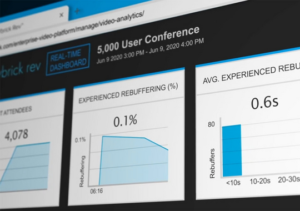
Video communication is important, but it can be difficult for IT personnel to say with certainty that their video assets are delivering intended results and meaningful experiences. If video quality declines and system administrators don’t have the insights needed to improve them, remote organizational culture could unravel.
Enterprises need a way to measure their videos. Video analytics software gives system administrators insight into the engagement and performance of both their live videos and on-demand assets, helping them determine whether they are providing value to their teams. Video analytics also help them decide which videos to remove from their libraries and which ones are still driving engagement.
Robust content management for global access
Hybrid and remote work environments function because video empowers business leaders to mimic in-person interactions. However, videos are only as valuable as employees’ ability to use them. Enterprises can have thousands of videos in their library. Still, if users can’t easily access them, they lose a great deal of value.
Enterprise video streaming enables easy access to video files for employees across distributed workspaces, letting users effortlessly search for videos similar to how they navigate YouTube and other streaming sites, while automatic translation services deliver video in local languages and dialects.
Enjoy live streaming while maintaining security
Video content often contains sensitive personal and enterprise information that, if leaked, could expose the organization to financial, operational, and reputational risk. As cybersecurity threats continue to increase, however, businesses need to keep each video asset out of the hands of competitors or cybercriminals.
An enterprise video streaming solution comes equipped with an advanced security infrastructure to prevent malicious actors from penetrating networks and stealing private information. Businesses can also utilize workflows and access credentials to authorize only select individuals to create, edit, and view certain video assets, putting stricter controls on internal video usage to limit risks.
What to Look For in an Enterprise Video Platform
Five things determine whether a platform will work at your scale:
- Network delivery. Does it integrate with an eCDN, and which delivery methods — multicast, peer-to-peer, caching — does it support? This is the constraint that breaks most deployments, and it is the one most easily overlooked in a demo.
- Identity and permissions. Does it authenticate against your existing SSO, and can permissions be managed by group rather than by individual video?
- Integration with where work happens. Employees will not adopt a separate destination. Integration with Microsoft Teams, Zoom and tools such as ServiceNow determines whether video is part of the working day or a place people have to be sent.
- Search and accessibility. Automatic transcription and captioning are a legal requirement in many jurisdictions and an adoption driver everywhere.
- Analytics that answer an operational question. Not view counts — playback quality by location, completion by audience, and where events degraded.
Vbrick Is the Enterprise Video Platform of Choice for Today’s Business
Hybrid and distributed working is now the default for most large organizations, and the expectation that internal video looks and behaves like the video people watch at home has come with it.
Vbrick combines a managed video platform with eCDN delivery — multicast, peer-to-peer and caching — so a single broadcast reaches every site without rebuilding the network, with access governed by your existing identity provider and end-to-end encryption in transit. Protected by uncompromising security and compliance standards, Vbrick is SOC 2 Type II audited, aligns with GDPR and international privacy requirements, and is the industry’s only FedRAMP-certified enterprise video platform.