

AI-Powered Video Content Analysis: Gain More Insights From Your Unstructured Media
Share on Social

AI-powered video content analysis uses speech recognition, computer vision, and language models to extract what is said, shown, and meant in a recording, then turns it into searchable metadata, summaries, and answers. The output is video content intelligence: enterprise video that can be searched, governed, and connected to workflows the same way documents are. This guide explains what video content analysis is, how multimodal AI performs it, the five steps of the pipeline, and where enterprises apply it.
Video has quickly become one of the most common ways organizations create and share information. Teams routinely record internal meetings, executive updates, training sessions, webinars, and customer interactions, creating a growing library of enterprise video content.
But simply storing those recordings doesn’t unlock their value.
A single department may generate hundreds of hours of footage each month. Multiply that across training, communications, marketing, and operations, and the result is a body of knowledge that is difficult to navigate without automation.
To turn video into a usable business resource, organizations need to analyze what’s inside it, and that’s where today’s multimodal AI-powered tools come in. These technologies can interpret speech, visuals, behavior, and context directly from video, making it possible to perform video content analysis at scale and transform unstructured media into enterprise intelligence.
What Is Video Content Analysis?
Video content analysis is the process of extracting meaning, patterns, and intelligence from recorded video, and its output is what we call video content intelligence. It can be as simple as generating an accurate transcript or summary, or as advanced as identifying behaviors, detecting trends, and recommending actions based on patterns found across many recordings.
In the past, analyzing video required manual review or converting recordings into structured formats before they could be evaluated. Today’s AI video analysis tools use computer vision, natural language processing, and machine learning to interpret video directly.
This allows organizations to analyze large video libraries quickly and consistently.
In practice, video content analysis lets organizations treat video the same way they treat other forms of enterprise data. Instead of manually watching recordings to locate information, AI systems scan footage, identify key moments, and surface relevant knowledge automatically.
For example, a global organization may want to understand how priorities are communicated across regions. Rather than reviewing dozens of town hall recordings manually, an AI video analyzer can detect recurring themes, extract insights, and provide a clear summary of how messaging is delivered.
Why Multimodal AI Changes the Equation
Earlier approaches to video analysis relied on separate tools that examined either audio or visual elements on their own. One system might have generated a transcript, while another identified objects or scenes, leaving organizations to piece the results together manually. This fragmented approach limited how deeply videos could be analyzed and made it difficult to scale across large video libraries.
Multimodal AI changes that by bringing these inputs together into a single analytical framework. Vbrick’s AI capabilities combine what is said, what is shown, and the surrounding context to create meaningful metadata and insights that make video easier to understand and search.
In practical terms, this means organizations can interact with video content across transcripts, visuals, and related materials at the same time, enabling richer discovery and faster access to knowledge.
This integrated approach combines several capabilities:
- Speech recognition to generate transcripts and summaries automatically
- Computer vision and AI analysis to review video and extract actionable insights
- Automated metadata creation that improves search and discovery across large libraries
- Contextual intelligence that turns video into a dynamic data layer for workflows and decision-making
Because these capabilities operate together, organizations can move beyond surface-level analytics and unlock the knowledge embedded in video content, transforming previously passive recordings into usable enterprise intelligence.
Key Steps of Video Management for Analysis
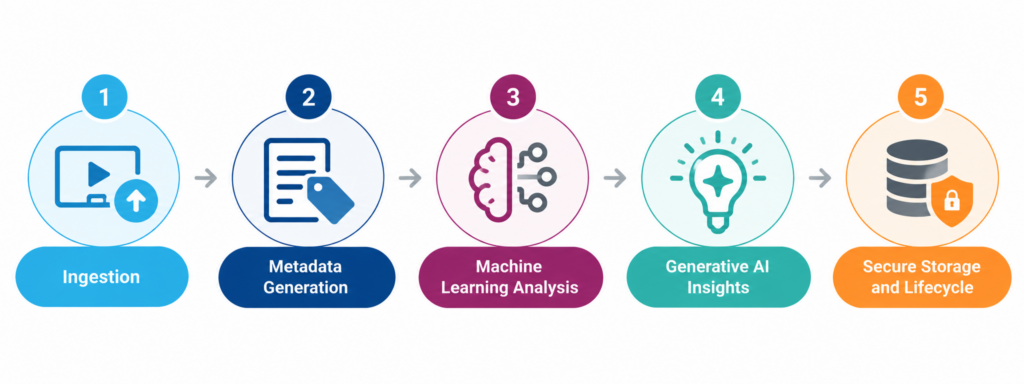
Effective video content analysis depends on having the right foundation. Before organizations can extract insights from video, they need a video management platform that keeps recordings organized, governed, and ready for analysis rather than scattered across disconnected systems.
These platforms support several important steps that transform raw video into usable enterprise data:
Ingestion
Video content is securely added to a centralized library, whether it originates from live streams, uploaded files, or integrated collaboration tools such as virtual meeting platforms. Centralized ingestion ensures that recordings are captured consistently and stored in a way that makes them available for downstream analysis without requiring manual collection.
Metadata Generation
AI automatically enriches recordings with searchable metadata such as speakers, timestamps, keywords, and topics discussed. This step makes video content discoverable in the same way organizations search documents or emails, eliminating the need to rely on file names or manual tagging.
Machine Learning Analysis
Algorithms process audio and visual elements to perform detection, recognition, and classification tasks. These may include identifying participants, detecting on-screen content, recognizing recurring themes, or analyzing how information is presented. This stage transforms unstructured video into analyzable data.
Insight Generation Through Generative AI
Generative AI tools build on this analysis by summarizing discussions, highlighting key moments, and extracting actionable insights. Instead of reviewing entire recordings, users can quickly access concise overviews, recommended follow-ups, or important decisions captured during the video.
Secure Storage and Lifecycle Management
Enterprise video platforms manage content according to governance policies, ensuring videos are retained, archived, or deleted as required. This supports compliance, protects sensitive information, and prevents uncontrolled growth of video libraries.
Another critical aspect of video management is integration. Modern platforms connect video analytics with broader enterprise analytics environments, allowing organizations to correlate insights derived from video with operational data, training outcomes, or communication metrics. This integration helps ensure that video intelligence contributes directly to business processes rather than remaining isolated within a media repository.
By managing these steps cohesively, organizations create a reliable pipeline that turns everyday recordings into structured, searchable knowledge ready for analysis and decision-making.
How Video Content Analysis Works
Modern video content analysis uses AI-driven video analytics to interpret recordings in ways that mirror human understanding, but at a scale no team could match manually.
Capabilities include:
- Detection of faces, logos, and objects within video frames
- Scene detection to identify transitions or key moments
- Recognition of speakers and participants
- Optical character recognition to extract text from visuals
- Sentiment analysis to evaluate communication tone
- Automated content moderation to flag sensitive material
- Intelligent summarization of long recordings
Behind the scenes, AI video analysis relies on deep learning models trained to interpret both visual and linguistic signals. These models evaluate sequences of video frames, detect patterns, and connect observations to spoken language and context.
This layered approach allows systems not only to recognize what appears in footage, but also to understand why it matters.
Video Content Analysis Use Cases
With scalable analysis in place, organizations can apply video intelligence directly to business workflows, improving how teams learn, collaborate, and make decisions.
Common use cases include:
Meeting Intelligence
AI-generated summaries surface decisions, action items, and discussion highlights so employees can stay aligned without reviewing entire recordings.
Training Optimization
Analysis of training sessions reveals engagement patterns and knowledge gaps, helping organizations refine learning programs and improve outcomes.
Customer and Market Insights
Sentiment and contextual analysis of recorded interactions uncover trends that inform product development and communication strategies.
Compliance and Content Moderation
Automated review detects sensitive information and supports governance policies while reducing the need for manual oversight.
Operational Awareness
Video analytics highlights workflow improvements, recurring challenges, and examples of best practices across teams.
By making video knowledge searchable and analyzable, organizations can preserve expertise, reduce duplication of effort, and ensure insights remain accessible over time.
A purpose-built business video platform makes this sustainable at scale: one governed library, automatic metadata, analysis without manual review, and integrations that carry results into the systems where work happens.
The Future of Video Content Intelligence
As multimodal AI continues to evolve, video content analysis will become even more tightly integrated with enterprise analytics and decision-making systems.
Rather than treating video as a separate content type, enterprises will view it as a core data source that contributes to analytics, innovation, and measurable outcomes.
This shift reflects a broader movement toward intelligence-driven organizations where insights can be derived from any format, including visual content.
Frequently Asked Questions About AI Video Content Analysis
Get More Out of Video Content
Video is one of the richest sources of enterprise knowledge available today, but only if organizations have the tools to analyze and activate it.
AI-powered video content analysis allows businesses to unlock the intelligence within their recordings, turning unstructured media into searchable, governed, and insight-driven assets.
Vbrick’s platform enables organizations to apply multimodal AI, video analytics, and enterprise-grade management to gain more value from every recording.
See how Vbrick AI structures and delivers video intelligence across your workflows, read how it fits into enterprise video intelligence more broadly, compare corporate video platforms, or request a demo.