
What Is an Enterprise Content Delivery Network (eCDN)?
An enterprise content delivery network (eCDN), sometimes called an enterprise CDN, distributes video inside your private network so one stream can serve thousands of viewers. Without one, every click to watch opens a separate session back to the video platform: a CEO broadcast to 10,000 employees means 10,000 streams crossing the corporate WAN, and the network slows for everyone. Read what an enterprise content delivery network is and how the delivery methods differ.
Keep Your Employees Connected With Vbrick Universal eCDN Solutions
Vbrick Universal eCDN distributes video traffic across your network so every employee gets a clean stream, and your video stays encrypted end to end. Peer-to-peer, edge caching, and multicast are included, so the architecture fits the network you have today and the one you will have next year.
Built for the Future, Optimized for Your Enterprise
Vbrick Universal eCDN offers unparalleled flexibility to meet your network’s unique needs. Our suite of eCDN technologies, peer-to-peer, edge caching, and multicast, can be used independently or together for optimized video delivery. Vbrick will help you navigate changes with confidence at every stage of your network’s growth.


Which eCDN Delivery Method Fits Your Network?
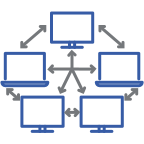
The right eCDN depends on your network more than on your video platform. Vbrick Universal eCDN gives you all three methods, so you choose per site instead of per vendor.
- Multicast sends one stream that your routers duplicate only where paths to viewers diverge, so bandwidth stays flat no matter how many people watch. It needs multicast enabled on routers, switches, and wireless controllers, and it is the most efficient option for large wired offices.
- Peer-to-peer shares the stream between viewers’ browsers on the same subnet, with no downloads, installs, or network changes. It is the fastest to deploy and the best fit for viewers on Wi-Fi, VPN, or at home.
- Edge caching stores a copy of the stream on a local or remote cache so a branch office pulls from the cache instead of the origin. It suits sites with predictable, repeat viewing and on-demand libraries.
A single town hall can reach headquarters over multicast, branch offices from a cache, and remote employees peer-to-peer, all from the same broadcast. For a fuller explanation of how each method works, read our guide to enterprise content delivery networks.

One eCDN for Microsoft Teams, Webex, and
Vbrick Enterprise Video Platform (EVP)
Vbrick Enterprise Video Platform (EVP)

Most enterprises broadcast from more than one platform. Vbrick Universal eCDN serves them from one deployment:
- Microsoft Teams: Vbrick has partnered with Microsoft to provide an eCDN for Teams, including town hall support. Microsoft eCDN is Microsoft’s first-party option; Teams also supports third-party eCDN providers through a documented integration. Link Microsoft Teams to .
- Webex Webinars: deep integration for live events streamed from Webex.
- Vbrick EVP: the eCDN is built into Vbrick’s EVP, so live and on-demand video from your own library gets the same delivery without a second product. Link enterprise video platform to https://vbrick.com/enterprise-video-platform/.
Custom sources, protocols, and delivery methods are supported through the Vbrick SDK.
eCDN Solutions Help Solve Hybrid Work Challenges
Remote and hybrid work pushed live and on-demand video into every part of the enterprise, and employees returning to the office have brought those viewing habits with them. That traffic can choke a corporate network that was not built for it. With an eCDN in place, employees get the same video quality at home and at their desk.